Search is changing.
People are no longer using search engines only to find a list of websites. They are increasingly asking questions in natural language and expecting direct, useful answers from AI-powered search experiences.
Google has expanded generative AI experiences such as AI Overviews and AI Mode, changing how people discover information, brands, products and services.
For businesses, this creates an important question:
The short answer is:
SEO is still the foundation — but your SEO strategy needs to evolve.
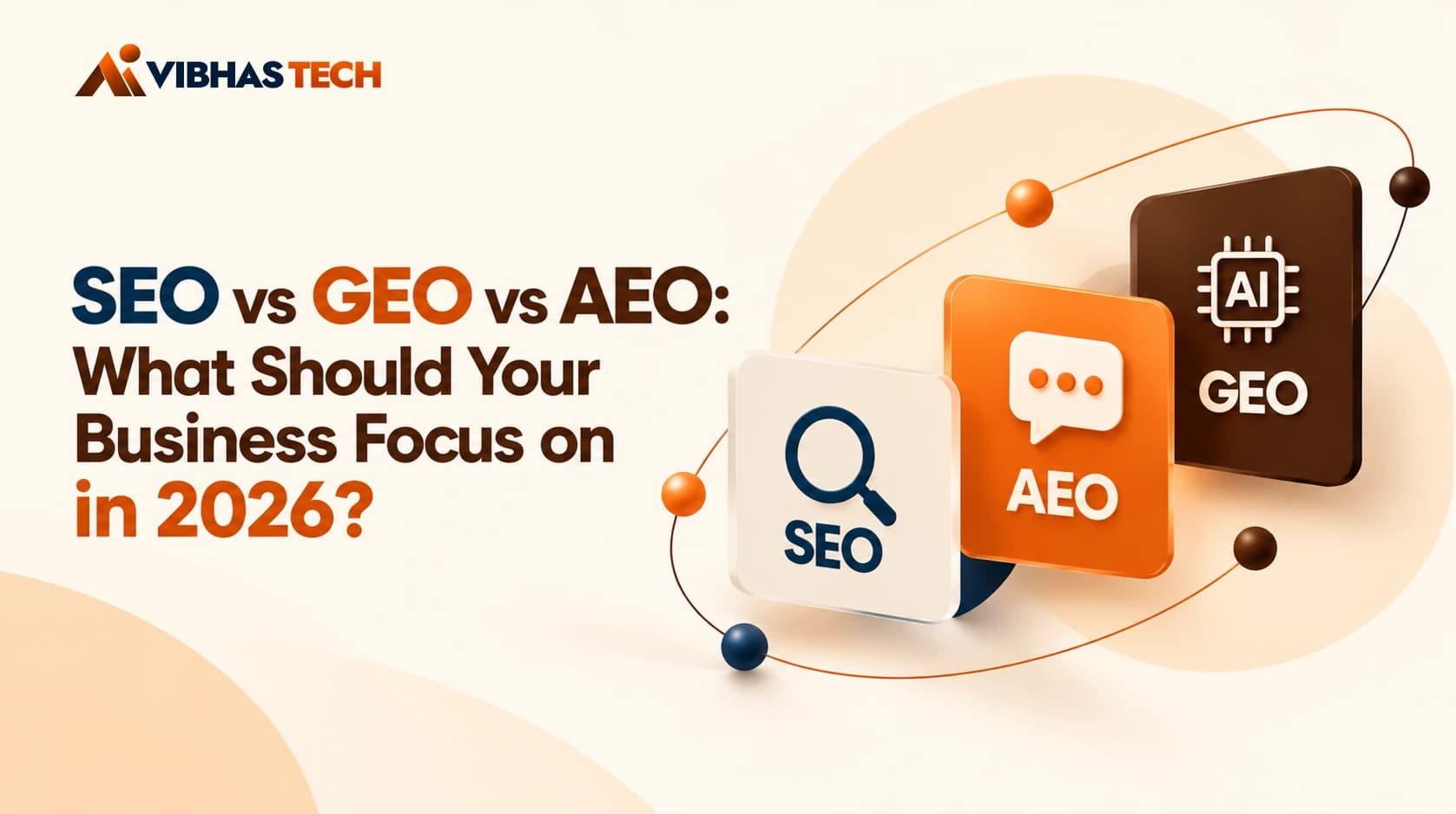
You may also have heard terms such as AEO (Answer Engine Optimization) and GEO (Generative Engine Optimization).
But what do they mean, and what should your business focus on in 2026?
Let's break it down.
What Is SEO?
SEO, or Search Engine Optimization, is the process of improving your website and online presence so search engines can better discover, understand and rank your content.
SEO includes:
- Keyword research and search intent
- Technical SEO
- Website performance
- Mobile usability
- Content optimization
- Internal linking
- Structured data
- Backlinks and authority
- Local SEO
- Crawlability and indexing
For example, if someone searches “digital marketing agency in Ahmedabad,” SEO helps your business compete for visibility when that potential customer searches for relevant services.
But modern SEO isn't simply about adding keywords to a webpage.
It's about creating a website that is useful, relevant, fast, understandable and trustworthy.
What Is AEO?
AEO stands for Answer Engine Optimization.
AEO generally refers to creating and structuring content so that it can clearly answer questions in answer-focused search experiences.
For example, instead of only targeting:
“best website development company”
you can create content that answers:
“What should I look for when choosing a website development company?”
AEO focuses on content that:
- Answers real customer questions
- Uses clear headings
- Provides direct explanations
- Covers related questions
- Uses natural language
- Makes important information easy to find
- Demonstrates expertise and credibility
For example:
- How much does a business website cost?
- What pages should a business website have?
- How long does website development take?
- What makes a website SEO-friendly?
- How can a website generate more leads?
The goal isn't to create content simply because a keyword exists.
The goal is to answer questions that matter to your customers.
What Is GEO?
GEO stands for Generative Engine Optimization.
The term is commonly used to describe efforts to improve how a business, website or brand is represented in generative AI search experiences.
For example, a potential customer might ask an AI-powered search system: “What are the best digital marketing agencies for a small business?”
Instead of receiving only traditional search results, the user may receive a generated response discussing companies, services or recommendations.
This creates an important question:
Is your business discoverable, understandable and credible enough to be represented accurately?
GEO discussions commonly focus on:
- Brand authority
- Useful content
- Clear business information
- Topical expertise
- Online mentions
- Credible references
- Consistent business information
However, GEO isn't a replacement for SEO.
Businesses should not abandon SEO simply because AI search is growing. Instead, they should strengthen their overall digital foundation.
SEO vs AEO vs GEO: What's the Difference?
| SEO | AEO | GEO |
|---|---|---|
| Search Engine Optimization | Answer Engine Optimization | Generative Engine Optimization |
| Search visibility | Answering questions | Generative AI visibility |
| Keywords and search intent | Questions and direct answers | Context, relevance and authority |
| Organic search | Answer-focused content | AI-generated experiences |
| Technical + content optimization | Clear, structured information | Brand and content visibility |
The important thing to understand is that these aren't three completely separate marketing strategies.
They overlap.
SEO is the foundation. AEO focuses on clear answers. GEO focuses on visibility in generative AI experiences.
Why SEO Still Matters in the Age of AI
One common misconception is:
“AI is replacing search, so SEO doesn't matter anymore.”
That's not the right way to look at it.
AI-powered search still depends on information from the web, content quality and relevance.
So rather than abandoning SEO, businesses should expand their SEO strategy.
A simple way to look at it is:
Your website needs a strong foundation before worrying about advanced AI-search visibility.
How AI Search Is Changing the Customer Journey
The traditional customer journey often looked like:
AI-powered search can introduce another layer:
This doesn't mean websites are becoming irrelevant.
Instead, it creates another opportunity for businesses to become useful sources of information.
The question is no longer only:
“Can I rank for this keyword?”
It is also:
“Does my website provide information worth discovering and referencing?”
8 Ways to Prepare Your Website for AI Search in 2026
Create Original, Useful Content
Don't create content simply because you want to target another keyword.
Ask:
Does this article actually help my customer?
Provide practical examples, recommendations and your own insights.
Answer Real Customer Questions
Your customers already have questions. Use them to guide your content strategy.
For example:
- How much does SEO cost?
- How long does SEO take?
- Should I redesign my website?
- How can I increase website leads?
- Is social media marketing worth it?
- What is GEO?
- How can my business appear in AI search?
These questions can become blog topics, service-page content, guides, FAQs and videos.
Instead of guessing what your audience wants to read, build content around what they actually want to know.
Build Topical Authority
Don't publish one article about a topic and move on.
If SEO is one of your core services, your website could cover:
- SEO for small businesses
- Local SEO
- Technical SEO
- On-page SEO
- SEO content strategy
- Common SEO mistakes
- SEO vs PPC
- SEO vs GEO vs AEO
- How to measure SEO performance
This creates a deeper resource around your important services.
Improve Your Technical SEO
Great content can't compensate for a poorly functioning website.
Regularly check:
- Website speed
- Mobile usability
- Indexing
- Broken links
- Internal links
- XML sitemap
- HTTPS
- Page structure
- Structured data
- Crawlability
Your website should be easy for both users and search engines to understand.
Make Your Business Information Clear
Make sure your website clearly communicates:
- Who you are
- What you do
- Who you serve
- Where you operate
- What services you offer
- What makes your business different
- How customers can contact you
Don't make visitors or search systems guess what your company does.
Build Brand Authority Beyond Your Website
Your website shouldn't exist in isolation.
Build a wider digital presence through:
- Social media
- Business listings
- Industry publications
- Relevant websites
- Reviews
- PR
- Partnerships
- Quality backlinks
- Original research
The objective isn't to collect hundreds of random mentions.
It's to build a credible and consistent digital footprint.
Use AI as a Tool — Not a Replacement for Expertise
AI can help with research, ideas, outlines, analysis and productivity.
But publishing large amounts of generic AI-generated content isn't a sustainable content strategy.
A better approach is:
AI + Human Expertise + Original Insights + Fact Checking
AI can help you work faster, but it shouldn't replace your knowledge and experience.
Track How Search Is Changing
Your SEO reporting shouldn't focus only on keyword rankings.
Monitor:
- Organic traffic
- Search impressions
- Click-through rate
- Conversions
- Top-performing pages
- Search queries
- Brand searches
- Content performance
- Website engagement
Search is becoming increasingly multimodal and conversational, so your digital strategy should evolve with it.
A Simple Website Audit Example
Imagine a local business has a website that looks good but isn't generating enough enquiries.
A basic audit might reveal:
- Important service pages are missing
- Page titles don't match search intent
- The website loads slowly on mobile
- Service content is too generic
- Calls-to-action are unclear
- Blog content doesn't answer customer questions
- Internal linking is weak
- Business information isn't clearly presented
The solution isn't necessarily to redesign everything.
Some improvements may involve content, while others may involve technical SEO, UX, performance or conversion strategy.
At Vibhas Tech, a website audit should be more than a list of technical errors.
The goal is to identify practical opportunities for improvement and turn them into an actionable roadmap.
Should Your Business Focus on SEO, AEO or GEO?
Here's the simple answer:
A practical strategy looks like this:
Make your website technically sound and easy to understand.
Answer the questions your customers actually ask.
Create high-quality resources around your core services.
Build credibility across your website and wider digital presence.
Monitor how your business is discovered across modern search and AI-powered experiences.
This approach is more sustainable than chasing every new “AI SEO trick.”
Our Take at Vibhas Tech
At Vibhas Tech, we don't see SEO, AEO and GEO as three completely separate strategies.
We see them as different parts of the same digital ecosystem.
A business first needs a strong website.
Then it needs useful content.
Then it needs authority and trust.
Because the goal isn't simply to get more traffic.
The goal is to attract the right people and turn digital visibility into meaningful business growth.
What Should Small Businesses Do in 2026?
Small businesses don't need a massive AI-search department.
Start with the fundamentals:
- 01Build a professional website.
- 02Make sure your website is technically optimized.
- 03Identify the questions your customers ask.
- 04Create genuinely useful answers.
- 05Build content around your core topics.
- 06Improve your local and online presence.
- 07Build genuine authority and trust.
- 08Use AI responsibly to improve productivity.
- 09Fact-check AI-assisted content.
- 10Track your performance and update your strategy.
The goal isn't to do everything at once.
Start with the fundamentals and improve consistently.
The Future of Search Isn't Just About Rankings
For years, digital marketing revolved around one question:
“What position does my website rank at?”
That's still important.
But businesses also need to think about:
- Can people discover my brand?
- Can search engines understand my business?
- Does my content answer important questions?
- Does my website demonstrate expertise?
- Is my brand represented accurately across the web?
- Can my content be useful in AI-powered search experiences?
The goal isn't simply to “rank #1.”
The goal is to build a digital presence that is:
Discoverable. Useful. Understandable. Trustworthy. Worth recommending.
Final Thoughts: SEO Isn't Dead — It's Evolving
SEO, AEO and GEO shouldn't be viewed as competing strategies.
They are different ways of thinking about visibility in an evolving search ecosystem.
SEO helps people discover your website.
AEO helps your content answer questions clearly.
GEO is commonly used to describe visibility within generative AI experiences.
But the foundation remains the same:
Create something genuinely useful for your audience.
Businesses shouldn't focus on chasing shortcuts or trying to manipulate every new search feature.
Instead, focus on building:
- A technically strong website
- Useful and original content
- A credible brand
- A better user experience
- A digital presence people can trust
The businesses that adapt successfully won't necessarily be the ones producing the most content.
They'll be the ones producing the most useful content and building the strongest digital presence.
Is Your Website Ready for the Next Generation of Search?
At Vibhas Tech, we help businesses build stronger digital foundations through:
SEO • Website Development • Digital Marketing • Content Marketing • AI & Digital Innovation
Not sure what's holding your website back?
Get a FREE Website Audit
We'll help identify opportunities across:
- 🔍 SEO
- ⚡ Website Performance
- 📱 User Experience
- 📈 Conversion Opportunities
- 🤖 AI-Search Readiness
No cost. No obligation. Just actionable insights.
Vibhas Tech • Digital Solutions. Meaningful Growth.
Frequently Asked Questions
SEO stands for Search Engine Optimization. It is the practice of improving a website and its online presence so search engines can better discover, understand and rank its content.
AEO stands for Answer Engine Optimization. It generally refers to creating and structuring content so it can clearly answer questions in answer-focused search experiences.
GEO stands for Generative Engine Optimization. The term is commonly used for strategies intended to improve visibility and representation within generative AI search experiences.
Yes. SEO remains an important foundation for website visibility, including in the context of Google's generative AI search experiences.
No. AI can assist with research, analysis and content workflows, but businesses still need technical optimization, strategy, expertise, original value and human review.
AI can be useful for research, brainstorming and drafting. However, content should be reviewed for accuracy, relevance, originality and value before publication.
Start with strong SEO fundamentals, create useful original content, answer customer questions clearly, demonstrate expertise, maintain accurate business information and build a credible online presence.
You don't necessarily need a separate "GEO strategy." A strong SEO and content strategy can support visibility in generative AI search experiences.
Businesses should prioritize a technically strong website, useful original content, search-intent alignment, topical authority, brand credibility and a good user experience while continuing to adapt to changes in search.